
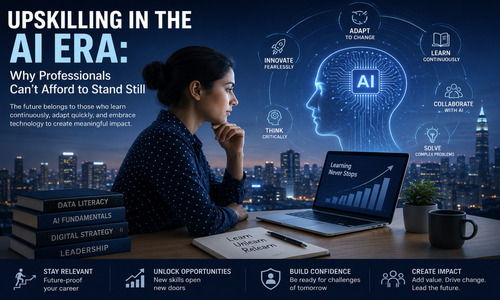
Artificial intelligence is no longer a futuristic concept reserved for tech companies and research labs. It is reshaping industries, redefining job roles, and changing how organizations operate. From finance and healthcare to manufacturing and marketing, AI-driven technologies are influencing decision-making, automation, and customer experiences. In such a rapidly evolving landscape, remaining static is no longer an option for professionals who aspire to stay relevant and competitive.
Traditional career paths were once built on degrees and years of experience. Today, the value of a professional increasingly depends on their ability to continuously learn and adapt. Technical knowledge, digital literacy, analytical thinking, and problem-solving capabilities have become critical assets. Employers are placing greater emphasis on skills rather than credentials alone, making lifelong learning an essential part of career development.
While concerns about automation replacing jobs continue to dominate discussions, the reality is more nuanced. Artificial intelligence is transforming roles rather than eliminating human value. Routine and repetitive tasks are increasingly automated, allowing professionals to focus on creativity, strategic thinking, collaboration, and innovation. Those who understand how to work alongside AI technologies will be better positioned to unlock new opportunities and drive organizational growth.
The future belongs to professionals who combine domain expertise with digital capabilities. Engineers are learning data analytics, marketers are embracing AI-powered tools, and managers are acquiring knowledge in digital transformation and emerging technologies. These hybrid skill sets enable individuals to bridge the gap between technical innovation and business strategy, creating greater value for organizations and enhancing career prospects.
In an environment where technologies evolve faster than ever, learning can no longer be viewed as a one-time activity. Continuous upskilling has become a strategic advantage for both individuals and businesses. Professionals who invest in acquiring new skills are more adaptable to change, better equipped to navigate disruptions, and more likely to emerge as leaders in their respective fields. Organizations are also recognizing that a culture of learning is essential for sustaining innovation and maintaining competitiveness.
As industries evolve, professionals are increasingly turning to executive education programs to acquire specialized knowledge and leadership capabilities. Flexible and industry-relevant learning formats enable working professionals to enhance their expertise without interrupting their careers. Executive education provides access to cutting-edge insights, practical frameworks, and valuable networks, empowering individuals to accelerate their professional growth and remain future-ready.
Although technology continues to advance, uniquely human capabilities remain irreplaceable. Leadership, emotional intelligence, communication, adaptability, and critical thinking are becoming increasingly important in an AI-driven world. These skills enable professionals to manage complexity, foster collaboration, and make ethical decisions that technology alone cannot replicate.
Businesses that prioritize employee development are better positioned to navigate uncertainty and embrace innovation. Investing in upskilling initiatives not only improves productivity but also strengthens employee engagement and retention. Companies that cultivate a learning-oriented culture are more likely to build resilient workforces capable of thriving in a changing global economy.
The AI revolution is not merely a technological shift; it represents a fundamental transformation in the nature of work itself. In this new era, the greatest risk is not automation but complacency. Professionals who embrace continuous learning and proactively develop new capabilities will be better prepared to seize emerging opportunities and shape the future rather than be disrupted by it.
The future will belong to those who are willing to evolve. As artificial intelligence continues to redefine industries and careers, upskilling is no longer a choice but a necessity. By investing in knowledge, embracing lifelong learning, and developing both technical and human skills, professionals can ensure they remain valuable contributors and effective leaders in an increasingly intelligent world.
 Rajbir Singh, PhD
Rajbir Singh is a founder and Consulting Partner at Value Centria, a boutique business consulting firm that leverages customer centricity and digital to drive growth and innovation. Additionally, he is the co-founder and CEO of the i4 Mentors Foundation, a startup accelerator. As a not-for-profit, i4 Mentors Foundation is working for “Build for India”, and Healthcare is one of their focus sectors.
Before this, Rajbir led Global Business and IT Consulting businesses at IBM, Oracle, HCL Technologies and Tata Unisys for 25+ years. He has led large, multi-cultural teams spread across the globe and has consulted with Fortune 500 clients across industries, including BFSI, Media, Telecom, Utilities, CPG and Manufacturing. His areas of expertise include Customer Strategy, Innovation Strategy, Business Strategy and Change Management. He has received recognition from Forrester, Pega, SAP and HCL Tech for developing innovative products.
Rajbir has been a visiting faculty at IIIT Delhi, IIT Delhi, NSUT and BIMTech. He is also on the board of a few startup incubators.
Rajbir is an Electronics Engineer from IIT Delhi, an MBA from IIM Bangalore and a PhD from IIT Delhi.
Websites: https://www.valuecentria.in/; https://www.i4mentors.com/
 Sudarsan Chakravarthy
Founder, Chief Mentor & Success Coach – myDharma Global
A Spiritual leader, leadership coach, motivational speaker, accomplished global business leader, and an author with keen interests in ancient wisdom, spirituality, science, philosophy, and the arts.
An MBA from the Indian Institute of Management, Bangalore (IIM-B, Class of 93), India’s premier B-School, with a proven track record in building business, driving revenue & profitability growth and maximizing stakeholder delight.
Versatile and highly accomplished Management Professional with 25+ years of experience in the IT industry spanning across India, ME, Europe and North America.
Has rich experience across a wide range of areas – Digital Transformation, Line of Business Management, Business Operations, Sales, Marketing, IT Strategy, Operations, Finance, Product Management, and Service Delivery Management.
Worked with GBM (IBM GMSR) in Dubai for 20+years and championed several key strategies, including Business transformation, SAP implementation, Market Coverage, Growth Initiatives, Merger, Organizational restructuring, Low-cost services delivery, Market Research, IT Strategy, Business Partner / Channel Management, Operational Excellence, Sales Management, CRM, etc.
A motivational speaker with rich experience in running inspiring empowerment workshops; Has been inspiring and enthralling audiences of all age groups – individuals, groups, youth, families, corporate leaders – across several parts of the world with his captivating lectures; Meticulously gleans profound insights from the treasury of ancient wisdom and presents them in a way that illuminates the contemporary mind and resonates with today’s needs, interests, and challenges.
His life’s mission is to instill nobility and greatness across various strata of society.
Skillfully harmonizes the seemingly conflicting material and spiritual worlds and empowers individuals with a revitalising transformation and helps them to strengthen faith in their limitless potential; Is dedicated to unlocking the God given talents and highest abilities in people and empowering them to celebrate life through their unique contributions to the making of a new and beautiful world.

Subha Parthasarathy has been working with children, parents, and adults since 2006 and is the founder of Magichive. She is a Counselling Psychologist with over 20,000 counselling and training hours spent on 1-on-1 sessions with adults/children and group training sessions. Subha is an experienced trainer and facilitator who delivers workshops and programs that focus on enriching relationships with self and others. Her workshops “Chetana” (parenting workshop since 2009) and “Compassionate Communication based on NVC (since 2016)” are centred around increasing self-awareness and equipping participants with tools and insights that can help in leading an enriching life.
Person Centric Therapy, Mindfulness, and Nonviolent Communication form the cornerstones of her work. She is a Vipassana meditator and has certifications on various methods of interventions based on NLP, CBT, TA, NVC, Gestalt, Movement therapy, Reiki, Deep Listening, etc. She has delivered sessions in IIM Bangalore, IIM Kashipur, Infosys, Infosys BPO, Cap Gemini, Northern Trust, HSBC, etc.
Case Study: Case study on Magichive through Ivey Publishing, Ivey Business School, Canada (Click here for details) published in Oct 2024
Podcasts: Subha has hosted more than 20 free podcasts centred around mindfulness hosted on Spotify ( Click here for details)
Book: A book of 19 poems titled “Verses for Better – Parenting Lessons from Parenting Failures“, a collaborative effort between Magichive and Wunderman Thompson, was published in 2018. The book was nominated for two categories in the prestigious National Level Kyoorious Creative Awards 2019.