
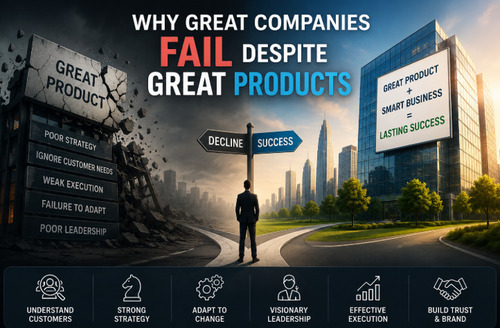
Innovation is often celebrated as the driving force behind business success. Companies invest billions in research and development to create products that are faster, smarter, and more advanced than ever before. Yet, history is filled with examples of organizations that introduced exceptional products but still failed to sustain their market position. This highlights an important truth: a great product may open the door to success, but it cannot guarantee long-term survival.
Successful companies understand that customers do not simply purchase products—they buy solutions, experiences, and trust. Businesses that focus solely on product innovation while neglecting strategy, customer relationships, or execution often struggle despite having superior offerings.
A technically superior product does not automatically translate into customer demand. Businesses must understand who their customers are, what problems they face, and how their product fits into everyday life. Companies that build products around engineering excellence instead of customer needs often discover that the market values convenience, affordability, and accessibility more than cutting-edge features.
Understanding customer behavior is therefore just as important as developing new technology. Organizations that actively gather feedback and adapt to changing expectations are far more likely to remain relevant.
Many companies underestimate the importance of a strong business strategy. Pricing, branding, distribution, partnerships, and marketing all play a critical role in determining whether a product reaches its intended audience. A revolutionary product with poor market positioning may receive praise from experts but fail to generate meaningful sales.
Successful businesses view product development as only one component of a much broader strategy. Every department from operations to finance must work together to create sustainable growth.
Markets evolve continuously due to technological advancements, economic conditions, and shifting consumer preferences. Companies that become complacent after initial success often lose their competitive advantage. While they continue improving existing products, competitors introduce new business models, embrace emerging technologies, and respond more quickly to customer demands.
Adaptability has become one of the most valuable characteristics of modern organizations. Companies willing to innovate beyond their products are better equipped to survive market disruptions.
Even the most innovative ideas require strong leadership to succeed. Leaders must allocate resources wisely, build high-performing teams, encourage innovation, and make timely strategic decisions. At the same time, operational excellence ensures that products are manufactured efficiently, delivered on time, and supported by excellent customer service.
Poor execution can damage customer trust regardless of how impressive the product itself may be. Businesses succeed when innovation is matched with consistent execution and a clear long-term vision.
A strong brand creates confidence and loyalty that extends beyond individual products. Customers often choose brands they trust because they associate them with reliability, quality, and excellent service. Companies that invest in long-term relationships with customers are better positioned to recover from setbacks and maintain their competitive advantage.
Building a successful business therefore requires more than creating an outstanding product—it requires creating an outstanding reputation.
The history of business demonstrates that innovation alone is not enough. Great companies succeed because they combine exceptional products with customer-centric thinking, sound business strategy, operational excellence, and the ability to adapt to change. Products may attract customers, but leadership, execution, and continuous improvement determine whether a company becomes a market leader or fades into history. In today’s competitive world, lasting success belongs not just to those who build great products, but to those who build great businesses.
 Rajbir Singh, PhD
Rajbir Singh is a founder and Consulting Partner at Value Centria, a boutique business consulting firm that leverages customer centricity and digital to drive growth and innovation. Additionally, he is the co-founder and CEO of the i4 Mentors Foundation, a startup accelerator. As a not-for-profit, i4 Mentors Foundation is working for “Build for India”, and Healthcare is one of their focus sectors.
Before this, Rajbir led Global Business and IT Consulting businesses at IBM, Oracle, HCL Technologies and Tata Unisys for 25+ years. He has led large, multi-cultural teams spread across the globe and has consulted with Fortune 500 clients across industries, including BFSI, Media, Telecom, Utilities, CPG and Manufacturing. His areas of expertise include Customer Strategy, Innovation Strategy, Business Strategy and Change Management. He has received recognition from Forrester, Pega, SAP and HCL Tech for developing innovative products.
Rajbir has been a visiting faculty at IIIT Delhi, IIT Delhi, NSUT and BIMTech. He is also on the board of a few startup incubators.
Rajbir is an Electronics Engineer from IIT Delhi, an MBA from IIM Bangalore and a PhD from IIT Delhi.
Websites: https://www.valuecentria.in/; https://www.i4mentors.com/
 Sudarsan Chakravarthy
Founder, Chief Mentor & Success Coach – myDharma Global
A Spiritual leader, leadership coach, motivational speaker, accomplished global business leader, and an author with keen interests in ancient wisdom, spirituality, science, philosophy, and the arts.
An MBA from the Indian Institute of Management, Bangalore (IIM-B, Class of 93), India’s premier B-School, with a proven track record in building business, driving revenue & profitability growth and maximizing stakeholder delight.
Versatile and highly accomplished Management Professional with 25+ years of experience in the IT industry spanning across India, ME, Europe and North America.
Has rich experience across a wide range of areas – Digital Transformation, Line of Business Management, Business Operations, Sales, Marketing, IT Strategy, Operations, Finance, Product Management, and Service Delivery Management.
Worked with GBM (IBM GMSR) in Dubai for 20+years and championed several key strategies, including Business transformation, SAP implementation, Market Coverage, Growth Initiatives, Merger, Organizational restructuring, Low-cost services delivery, Market Research, IT Strategy, Business Partner / Channel Management, Operational Excellence, Sales Management, CRM, etc.
A motivational speaker with rich experience in running inspiring empowerment workshops; Has been inspiring and enthralling audiences of all age groups – individuals, groups, youth, families, corporate leaders – across several parts of the world with his captivating lectures; Meticulously gleans profound insights from the treasury of ancient wisdom and presents them in a way that illuminates the contemporary mind and resonates with today’s needs, interests, and challenges.
His life’s mission is to instill nobility and greatness across various strata of society.
Skillfully harmonizes the seemingly conflicting material and spiritual worlds and empowers individuals with a revitalising transformation and helps them to strengthen faith in their limitless potential; Is dedicated to unlocking the God given talents and highest abilities in people and empowering them to celebrate life through their unique contributions to the making of a new and beautiful world.

Subha Parthasarathy has been working with children, parents, and adults since 2006 and is the founder of Magichive. She is a Counselling Psychologist with over 20,000 counselling and training hours spent on 1-on-1 sessions with adults/children and group training sessions. Subha is an experienced trainer and facilitator who delivers workshops and programs that focus on enriching relationships with self and others. Her workshops “Chetana” (parenting workshop since 2009) and “Compassionate Communication based on NVC (since 2016)” are centred around increasing self-awareness and equipping participants with tools and insights that can help in leading an enriching life.
Person Centric Therapy, Mindfulness, and Nonviolent Communication form the cornerstones of her work. She is a Vipassana meditator and has certifications on various methods of interventions based on NLP, CBT, TA, NVC, Gestalt, Movement therapy, Reiki, Deep Listening, etc. She has delivered sessions in IIM Bangalore, IIM Kashipur, Infosys, Infosys BPO, Cap Gemini, Northern Trust, HSBC, etc.
Case Study: Case study on Magichive through Ivey Publishing, Ivey Business School, Canada (Click here for details) published in Oct 2024
Podcasts: Subha has hosted more than 20 free podcasts centred around mindfulness hosted on Spotify ( Click here for details)
Book: A book of 19 poems titled “Verses for Better – Parenting Lessons from Parenting Failures“, a collaborative effort between Magichive and Wunderman Thompson, was published in 2018. The book was nominated for two categories in the prestigious National Level Kyoorious Creative Awards 2019.