
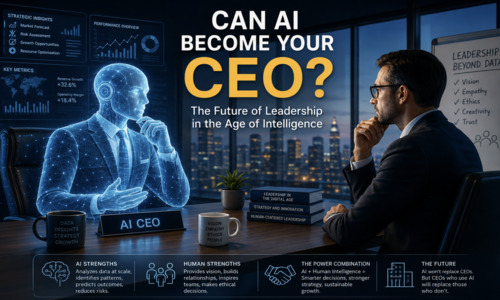
Artificial Intelligence has rapidly evolved from being a productivity tool to becoming an active decision-making partner. Today, AI writes reports, analyzes markets, predicts customer behavior, and even participates in boardroom discussions through advanced analytics. As organizations increasingly rely on AI to make strategic decisions, an intriguing question arises: could AI one day replace the Chief Executive Officer?
The role of a CEO has always centered around making complex decisions under uncertainty. From allocating capital and managing talent to navigating economic crises, executives process vast amounts of information before making strategic choices. AI has significantly enhanced this process by analyzing millions of data points within seconds, identifying hidden patterns, forecasting market trends, and providing recommendations with remarkable accuracy.
Companies across industries already use AI-powered dashboards to monitor operations, optimize supply chains, forecast sales, and assess financial risks. Rather than relying solely on intuition, executives are increasingly making data-driven decisions supported by intelligent algorithms.
AI possesses several capabilities that make it exceptionally valuable in executive functions. It can process enormous volumes of structured and unstructured data without fatigue, detect subtle trends that humans may overlook, and continuously learn from new information. Machine learning models can simulate different business scenarios, estimate financial outcomes, and recommend optimal strategies based on historical data.
For multinational corporations dealing with complex operations, AI can improve forecasting accuracy, optimize inventory levels, reduce operational costs, and identify emerging market opportunities faster than traditional methods. These capabilities enable leaders to make informed decisions with greater confidence.
Despite its analytical strengths, leadership extends far beyond data. Great CEOs inspire teams, build organizational culture, negotiate high-stakes partnerships, resolve interpersonal conflicts, and make ethical decisions that cannot always be reduced to numbers. Employees look to leaders for vision, empathy, and trust during times of uncertainty.
When unexpected crises arise, successful leadership often depends on emotional intelligence, creativity, and moral judgment. These qualities are deeply rooted in human experience and remain difficult for AI systems to replicate.
Some organizations have experimented with AI in executive roles. AI systems have been used to assist with investment decisions, pricing strategies, workforce planning, and customer engagement. In limited cases, AI has even been appointed as an advisory member of corporate boards, offering recommendations based on extensive data analysis.
However, these systems function as decision-support tools rather than autonomous leaders. Final responsibility for strategic direction, legal accountability, and stakeholder trust continues to rest with human executives.
Instead of replacing CEOs, AI is transforming how they lead. The future executive will combine human judgment with AI-powered intelligence. Routine analysis, forecasting, reporting, and operational optimization will increasingly be handled by AI, allowing leaders to focus on innovation, strategic vision, relationship building, and long-term growth.
This collaboration enables organizations to make faster decisions while preserving the human qualities essential for effective leadership. CEOs who embrace AI will likely outperform those who rely solely on traditional decision-making approaches.
Delegating executive decisions to AI introduces significant challenges. AI systems can inherit biases from historical data, produce opaque recommendations, and struggle with unprecedented situations. Questions surrounding accountability, transparency, privacy, and fairness become even more critical when AI influences strategic business decisions.
Organizations must establish clear governance frameworks to ensure AI remains explainable, secure, and aligned with ethical standards. Human oversight will continue to be indispensable, particularly when decisions affect employees, customers, and society.
The future of executive leadership is unlikely to be a contest between humans and machines. Instead, it will be defined by collaboration. AI will become an indispensable advisor, providing insights at a speed and scale beyond human capability, while human leaders will continue to provide vision, empathy, ethical judgment, and the ability to inspire people.
The CEO of tomorrow may rely on AI for nearly every major decision, but leadership itself will remain fundamentally human. The organizations that thrive will not be those led entirely by AI, but those where human intelligence and artificial intelligence work together to create smarter, faster, and more responsible decisions.
 Rajbir Singh, PhD
Rajbir Singh is a founder and Consulting Partner at Value Centria, a boutique business consulting firm that leverages customer centricity and digital to drive growth and innovation. Additionally, he is the co-founder and CEO of the i4 Mentors Foundation, a startup accelerator. As a not-for-profit, i4 Mentors Foundation is working for “Build for India”, and Healthcare is one of their focus sectors.
Before this, Rajbir led Global Business and IT Consulting businesses at IBM, Oracle, HCL Technologies and Tata Unisys for 25+ years. He has led large, multi-cultural teams spread across the globe and has consulted with Fortune 500 clients across industries, including BFSI, Media, Telecom, Utilities, CPG and Manufacturing. His areas of expertise include Customer Strategy, Innovation Strategy, Business Strategy and Change Management. He has received recognition from Forrester, Pega, SAP and HCL Tech for developing innovative products.
Rajbir has been a visiting faculty at IIIT Delhi, IIT Delhi, NSUT and BIMTech. He is also on the board of a few startup incubators.
Rajbir is an Electronics Engineer from IIT Delhi, an MBA from IIM Bangalore and a PhD from IIT Delhi.
Websites: https://www.valuecentria.in/; https://www.i4mentors.com/
 Sudarsan Chakravarthy
Founder, Chief Mentor & Success Coach – myDharma Global
A Spiritual leader, leadership coach, motivational speaker, accomplished global business leader, and an author with keen interests in ancient wisdom, spirituality, science, philosophy, and the arts.
An MBA from the Indian Institute of Management, Bangalore (IIM-B, Class of 93), India’s premier B-School, with a proven track record in building business, driving revenue & profitability growth and maximizing stakeholder delight.
Versatile and highly accomplished Management Professional with 25+ years of experience in the IT industry spanning across India, ME, Europe and North America.
Has rich experience across a wide range of areas – Digital Transformation, Line of Business Management, Business Operations, Sales, Marketing, IT Strategy, Operations, Finance, Product Management, and Service Delivery Management.
Worked with GBM (IBM GMSR) in Dubai for 20+years and championed several key strategies, including Business transformation, SAP implementation, Market Coverage, Growth Initiatives, Merger, Organizational restructuring, Low-cost services delivery, Market Research, IT Strategy, Business Partner / Channel Management, Operational Excellence, Sales Management, CRM, etc.
A motivational speaker with rich experience in running inspiring empowerment workshops; Has been inspiring and enthralling audiences of all age groups – individuals, groups, youth, families, corporate leaders – across several parts of the world with his captivating lectures; Meticulously gleans profound insights from the treasury of ancient wisdom and presents them in a way that illuminates the contemporary mind and resonates with today’s needs, interests, and challenges.
His life’s mission is to instill nobility and greatness across various strata of society.
Skillfully harmonizes the seemingly conflicting material and spiritual worlds and empowers individuals with a revitalising transformation and helps them to strengthen faith in their limitless potential; Is dedicated to unlocking the God given talents and highest abilities in people and empowering them to celebrate life through their unique contributions to the making of a new and beautiful world.

Subha Parthasarathy has been working with children, parents, and adults since 2006 and is the founder of Magichive. She is a Counselling Psychologist with over 20,000 counselling and training hours spent on 1-on-1 sessions with adults/children and group training sessions. Subha is an experienced trainer and facilitator who delivers workshops and programs that focus on enriching relationships with self and others. Her workshops “Chetana” (parenting workshop since 2009) and “Compassionate Communication based on NVC (since 2016)” are centred around increasing self-awareness and equipping participants with tools and insights that can help in leading an enriching life.
Person Centric Therapy, Mindfulness, and Nonviolent Communication form the cornerstones of her work. She is a Vipassana meditator and has certifications on various methods of interventions based on NLP, CBT, TA, NVC, Gestalt, Movement therapy, Reiki, Deep Listening, etc. She has delivered sessions in IIM Bangalore, IIM Kashipur, Infosys, Infosys BPO, Cap Gemini, Northern Trust, HSBC, etc.
Case Study: Case study on Magichive through Ivey Publishing, Ivey Business School, Canada (Click here for details) published in Oct 2024
Podcasts: Subha has hosted more than 20 free podcasts centred around mindfulness hosted on Spotify ( Click here for details)
Book: A book of 19 poems titled “Verses for Better – Parenting Lessons from Parenting Failures“, a collaborative effort between Magichive and Wunderman Thompson, was published in 2018. The book was nominated for two categories in the prestigious National Level Kyoorious Creative Awards 2019.