
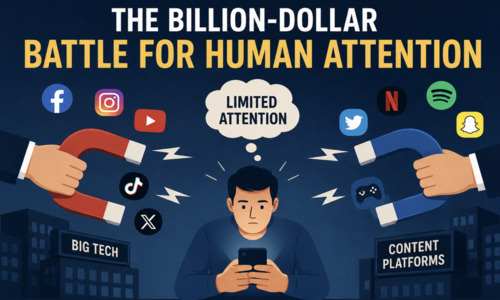
Attention has become one of the most valuable resources in the modern economy. In a world filled with endless notifications, advertisements, short videos, podcasts, streaming platforms, and social media feeds, companies are no longer just competing for money. They are competing for time, focus, and engagement.
Every scroll, click, watch, and interaction has economic value. Businesses now design products not only to serve customers but also to keep them engaged for as long as possible. The longer people stay connected, the more data companies collect, the more advertisements they can display, and the more revenue they generate.The battle for human attention has quietly become one of the largest economic wars in history.
Traditional industries focused on physical resources such as oil, land, and manufacturing capacity. The digital economy introduced a different type of resource: human attention.
Platforms today generate billions of dollars because they successfully capture user engagement. Streaming services compete for viewing hours, social media platforms compete for screen time, and e commerce companies compete for repeated interaction.
Attention directly influences purchasing behavior, brand awareness, and consumer loyalty. Companies that control attention often control markets.
This is why some of the largest technology firms in the world invest heavily in recommendation systems, personalization algorithms, and behavioral analytics. Their goal is simple: keep users engaged longer than competitors.
Modern digital platforms are built around behavioral psychology. Features such as infinite scrolling, autoplay videos, streak systems, personalized recommendations, and instant notifications are carefully designed to encourage repeated interaction.
Human brains naturally respond to unpredictability and rewards. Social media platforms use this principle effectively by continuously presenting new content, likes, comments, and updates that trigger curiosity and emotional responses.
The result is a feedback loop where users repeatedly return to platforms, often without consciously deciding to do so.
This design strategy has transformed engagement into a science.
Social media platforms are among the strongest examples of the attention economy in action. Their business models depend heavily on advertising revenue, which increases when users spend more time on the platform.
Algorithms are optimized to prioritize content that drives engagement, whether through entertainment, controversy, emotional reactions, or viral trends. As a result, attention often becomes more valuable than accuracy or depth.
This shift has changed not only marketing but also politics, journalism, entertainment, and even personal relationships. Viral visibility can now shape public opinion, influence elections, and create overnight celebrity culture.
The competition is no longer limited to companies. Individuals are also competing for digital attention.
One of the clearest examples of the attention battle is the rise of short form content. Platforms increasingly prioritize fast, highly stimulating videos designed to maximize retention.
Short form content works because it aligns with shrinking attention spans and instant gratification. Users consume large amounts of information rapidly, often without deep engagement or reflection.
For businesses, this creates opportunities and risks. Brands can reach millions quickly, but they also face the challenge of maintaining relevance in a rapidly changing digital environment.
Visibility has become easier to achieve but harder to sustain.
Behind every recommendation and advertisement lies data. Companies continuously analyze user behavior to understand preferences, habits, emotions, and decision making patterns.
Every interaction helps improve predictive systems. The more data platforms collect, the better they become at retaining attention.
This has raised important ethical questions regarding privacy, manipulation, and digital dependency. Critics argue that some platforms optimize engagement at the cost of mental well being and social balance.
At the same time, businesses view data driven personalization as essential for competitiveness in the digital economy.
The battle for attention is no longer limited to technology companies. Retail brands, financial institutions, educational platforms, and even healthcare providers are adopting engagement driven strategies.
Companies use gamification, personalized experiences, push notifications, and loyalty systems to increase interaction. Businesses increasingly measure success through engagement metrics alongside traditional financial indicators.
Attention has become a universal business currency.
While the attention economy has created innovation and growth, it has also introduced challenges. Information overload, reduced concentration, digital fatigue, and mental burnout are becoming increasingly common.
Consumers are constantly exposed to content competing for emotional and cognitive space. As competition intensifies, companies are pushed to create increasingly stimulating experiences to maintain engagement.
This creates a cycle where attention becomes fragmented and sustained focus becomes harder to maintain.
The competition for human attention will likely become even more aggressive with advancements in artificial intelligence, immersive technology, augmented reality, and personalized digital experiences.
Future systems may predict user behavior with greater accuracy and deliver hyper personalized content in real time. Businesses that understand consumer psychology, behavioral data, and engagement patterns will continue to dominate digital markets.
However, there is also growing demand for digital wellness, mindful technology use, and healthier online experiences. The future may not only depend on capturing attention but also on earning trust.
The modern economy is increasingly shaped by the ability to attract and retain human attention. What began as a marketing objective has evolved into a global economic strategy influencing technology, media, business, and society.
In this environment, attention is more than a metric. It is power, influence, and revenue combined.
The companies that win the billion dollar battle for attention are not simply selling products. They are shaping habits, behaviors, and the way people experience the world.
 Rajbir Singh, PhD
Rajbir Singh is a founder and Consulting Partner at Value Centria, a boutique business consulting firm that leverages customer centricity and digital to drive growth and innovation. Additionally, he is the co-founder and CEO of the i4 Mentors Foundation, a startup accelerator. As a not-for-profit, i4 Mentors Foundation is working for “Build for India”, and Healthcare is one of their focus sectors.
Before this, Rajbir led Global Business and IT Consulting businesses at IBM, Oracle, HCL Technologies and Tata Unisys for 25+ years. He has led large, multi-cultural teams spread across the globe and has consulted with Fortune 500 clients across industries, including BFSI, Media, Telecom, Utilities, CPG and Manufacturing. His areas of expertise include Customer Strategy, Innovation Strategy, Business Strategy and Change Management. He has received recognition from Forrester, Pega, SAP and HCL Tech for developing innovative products.
Rajbir has been a visiting faculty at IIIT Delhi, IIT Delhi, NSUT and BIMTech. He is also on the board of a few startup incubators.
Rajbir is an Electronics Engineer from IIT Delhi, an MBA from IIM Bangalore and a PhD from IIT Delhi.
Websites: https://www.valuecentria.in/; https://www.i4mentors.com/
 Sudarsan Chakravarthy
Founder, Chief Mentor & Success Coach – myDharma Global
A Spiritual leader, leadership coach, motivational speaker, accomplished global business leader, and an author with keen interests in ancient wisdom, spirituality, science, philosophy, and the arts.
An MBA from the Indian Institute of Management, Bangalore (IIM-B, Class of 93), India’s premier B-School, with a proven track record in building business, driving revenue & profitability growth and maximizing stakeholder delight.
Versatile and highly accomplished Management Professional with 25+ years of experience in the IT industry spanning across India, ME, Europe and North America.
Has rich experience across a wide range of areas – Digital Transformation, Line of Business Management, Business Operations, Sales, Marketing, IT Strategy, Operations, Finance, Product Management, and Service Delivery Management.
Worked with GBM (IBM GMSR) in Dubai for 20+years and championed several key strategies, including Business transformation, SAP implementation, Market Coverage, Growth Initiatives, Merger, Organizational restructuring, Low-cost services delivery, Market Research, IT Strategy, Business Partner / Channel Management, Operational Excellence, Sales Management, CRM, etc.
A motivational speaker with rich experience in running inspiring empowerment workshops; Has been inspiring and enthralling audiences of all age groups – individuals, groups, youth, families, corporate leaders – across several parts of the world with his captivating lectures; Meticulously gleans profound insights from the treasury of ancient wisdom and presents them in a way that illuminates the contemporary mind and resonates with today’s needs, interests, and challenges.
His life’s mission is to instill nobility and greatness across various strata of society.
Skillfully harmonizes the seemingly conflicting material and spiritual worlds and empowers individuals with a revitalising transformation and helps them to strengthen faith in their limitless potential; Is dedicated to unlocking the God given talents and highest abilities in people and empowering them to celebrate life through their unique contributions to the making of a new and beautiful world.

Subha Parthasarathy has been working with children, parents, and adults since 2006 and is the founder of Magichive. She is a Counselling Psychologist with over 20,000 counselling and training hours spent on 1-on-1 sessions with adults/children and group training sessions. Subha is an experienced trainer and facilitator who delivers workshops and programs that focus on enriching relationships with self and others. Her workshops “Chetana” (parenting workshop since 2009) and “Compassionate Communication based on NVC (since 2016)” are centred around increasing self-awareness and equipping participants with tools and insights that can help in leading an enriching life.
Person Centric Therapy, Mindfulness, and Nonviolent Communication form the cornerstones of her work. She is a Vipassana meditator and has certifications on various methods of interventions based on NLP, CBT, TA, NVC, Gestalt, Movement therapy, Reiki, Deep Listening, etc. She has delivered sessions in IIM Bangalore, IIM Kashipur, Infosys, Infosys BPO, Cap Gemini, Northern Trust, HSBC, etc.
Case Study: Case study on Magichive through Ivey Publishing, Ivey Business School, Canada (Click here for details) published in Oct 2024
Podcasts: Subha has hosted more than 20 free podcasts centred around mindfulness hosted on Spotify ( Click here for details)
Book: A book of 19 poems titled “Verses for Better – Parenting Lessons from Parenting Failures“, a collaborative effort between Magichive and Wunderman Thompson, was published in 2018. The book was nominated for two categories in the prestigious National Level Kyoorious Creative Awards 2019.