
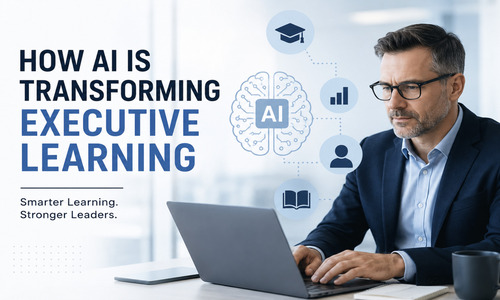
Executive learning is no longer limited to classrooms, fixed schedules, or traditional teaching methods. The rapid growth of artificial intelligence is reshaping how professionals learn, adapt, and develop leadership skills in a constantly evolving business environment. Companies today operate in industries where technology changes faster than ever, making continuous learning essential rather than optional.
AI is becoming a powerful force behind this transformation. From personalized learning experiences to intelligent coaching systems, it is changing the way executives consume knowledge and apply it in real-world decision making. Business leaders are now expected to understand not only management principles but also technological disruption, digital strategy, and data driven thinking.
One of the biggest limitations of traditional executive education was the one size fits all approach. Every professional entered a program with different levels of experience, strengths, and career goals, yet most learning environments treated everyone the same. AI is changing this by creating highly personalized learning experiences.
Modern AI powered platforms analyze user behavior, learning speed, preferences, and performance to recommend customized content. Executives can focus on areas where they need improvement while skipping concepts they already understand. This makes learning more efficient and relevant.
Instead of spending months following rigid structures, professionals can now receive tailored learning paths designed around their industry, leadership role, and future ambitions. This personalization improves engagement and helps executives gain practical knowledge faster.
Executive education increasingly focuses on solving real business problems rather than memorizing theories. AI driven simulations are making this process more immersive and realistic. Leaders can now participate in virtual business environments where they test strategies, respond to crises, and analyze outcomes in real time.
These simulations use large datasets and predictive models to recreate market conditions, customer behavior, and competitive challenges. Executives are able to experiment with decisions without real world financial risks. This creates a stronger connection between learning and practical application.
AI also enables instant feedback during these exercises. Instead of waiting for evaluations, professionals receive immediate insights into their decision making patterns, leadership style, and risk assessment abilities.
Traditional executive coaching was often expensive and limited to senior leadership. AI is making coaching more accessible through intelligent assistants and virtual mentors. These systems can provide guidance on communication, productivity, strategic thinking, and leadership development.
AI powered coaching tools analyze conversations, presentations, and work patterns to identify areas of improvement. They can suggest better communication styles, time management strategies, or negotiation approaches based on behavioral analysis.
While AI cannot fully replace human mentorship, it acts as a continuous support system that executives can access anytime. This combination of human expertise and intelligent technology is redefining professional development.
The business world changes too quickly for outdated learning models. By the time traditional course materials are updated, industries may already look different. AI helps executive education stay current by constantly integrating real time information and emerging trends.
Executives can now learn from live market data, industry reports, global economic shifts, and recent case studies generated through AI driven systems. This creates a dynamic learning environment where professionals stay connected to current realities rather than outdated examples.
The ability to access relevant knowledge instantly is becoming one of the most valuable aspects of modern executive learning.
Interestingly, the rise of AI is also increasing the importance of human centered leadership skills. As automation handles repetitive and analytical tasks, executives must focus more on creativity, emotional intelligence, ethical judgment, and strategic vision.
Executive education is therefore evolving beyond technical expertise. Programs now emphasize collaboration, adaptability, innovation, and people management alongside digital literacy. AI may transform how learning happens, but human leadership remains central to organizational success.
The future executive is not someone competing against AI, but someone capable of working effectively with it.
Despite its advantages, AI driven executive learning also raises important concerns. Data privacy, algorithmic bias, and over reliance on technology remain significant challenges. There is also the risk that learning becomes overly automated, reducing meaningful human interaction and critical discussion.
Educational institutions and companies must ensure that AI enhances learning rather than replacing the deeper thinking and collaboration that leadership development requires. The balance between technology and human connection will determine the long term success of AI in education.
AI is not simply improving executive education. It is fundamentally redefining it. Learning is becoming faster, more personalized, more accessible, and closely connected to real business challenges. Professionals no longer view education as something completed early in life. It is now a continuous process that evolves alongside careers and industries.
As businesses face increasing uncertainty and technological disruption, the ability to learn quickly may become one of the most important leadership advantages. In this new era, AI is not just a tool for automation. It is becoming a partner in shaping the future of leadership and professional growth.
 Rajbir Singh, PhD
Rajbir Singh is a founder and Consulting Partner at Value Centria, a boutique business consulting firm that leverages customer centricity and digital to drive growth and innovation. Additionally, he is the co-founder and CEO of the i4 Mentors Foundation, a startup accelerator. As a not-for-profit, i4 Mentors Foundation is working for “Build for India”, and Healthcare is one of their focus sectors.
Before this, Rajbir led Global Business and IT Consulting businesses at IBM, Oracle, HCL Technologies and Tata Unisys for 25+ years. He has led large, multi-cultural teams spread across the globe and has consulted with Fortune 500 clients across industries, including BFSI, Media, Telecom, Utilities, CPG and Manufacturing. His areas of expertise include Customer Strategy, Innovation Strategy, Business Strategy and Change Management. He has received recognition from Forrester, Pega, SAP and HCL Tech for developing innovative products.
Rajbir has been a visiting faculty at IIIT Delhi, IIT Delhi, NSUT and BIMTech. He is also on the board of a few startup incubators.
Rajbir is an Electronics Engineer from IIT Delhi, an MBA from IIM Bangalore and a PhD from IIT Delhi.
Websites: https://www.valuecentria.in/; https://www.i4mentors.com/
 Sudarsan Chakravarthy
Founder, Chief Mentor & Success Coach – myDharma Global
A Spiritual leader, leadership coach, motivational speaker, accomplished global business leader, and an author with keen interests in ancient wisdom, spirituality, science, philosophy, and the arts.
An MBA from the Indian Institute of Management, Bangalore (IIM-B, Class of 93), India’s premier B-School, with a proven track record in building business, driving revenue & profitability growth and maximizing stakeholder delight.
Versatile and highly accomplished Management Professional with 25+ years of experience in the IT industry spanning across India, ME, Europe and North America.
Has rich experience across a wide range of areas – Digital Transformation, Line of Business Management, Business Operations, Sales, Marketing, IT Strategy, Operations, Finance, Product Management, and Service Delivery Management.
Worked with GBM (IBM GMSR) in Dubai for 20+years and championed several key strategies, including Business transformation, SAP implementation, Market Coverage, Growth Initiatives, Merger, Organizational restructuring, Low-cost services delivery, Market Research, IT Strategy, Business Partner / Channel Management, Operational Excellence, Sales Management, CRM, etc.
A motivational speaker with rich experience in running inspiring empowerment workshops; Has been inspiring and enthralling audiences of all age groups – individuals, groups, youth, families, corporate leaders – across several parts of the world with his captivating lectures; Meticulously gleans profound insights from the treasury of ancient wisdom and presents them in a way that illuminates the contemporary mind and resonates with today’s needs, interests, and challenges.
His life’s mission is to instill nobility and greatness across various strata of society.
Skillfully harmonizes the seemingly conflicting material and spiritual worlds and empowers individuals with a revitalising transformation and helps them to strengthen faith in their limitless potential; Is dedicated to unlocking the God given talents and highest abilities in people and empowering them to celebrate life through their unique contributions to the making of a new and beautiful world.

Subha Parthasarathy has been working with children, parents, and adults since 2006 and is the founder of Magichive. She is a Counselling Psychologist with over 20,000 counselling and training hours spent on 1-on-1 sessions with adults/children and group training sessions. Subha is an experienced trainer and facilitator who delivers workshops and programs that focus on enriching relationships with self and others. Her workshops “Chetana” (parenting workshop since 2009) and “Compassionate Communication based on NVC (since 2016)” are centred around increasing self-awareness and equipping participants with tools and insights that can help in leading an enriching life.
Person Centric Therapy, Mindfulness, and Nonviolent Communication form the cornerstones of her work. She is a Vipassana meditator and has certifications on various methods of interventions based on NLP, CBT, TA, NVC, Gestalt, Movement therapy, Reiki, Deep Listening, etc. She has delivered sessions in IIM Bangalore, IIM Kashipur, Infosys, Infosys BPO, Cap Gemini, Northern Trust, HSBC, etc.
Case Study: Case study on Magichive through Ivey Publishing, Ivey Business School, Canada (Click here for details) published in Oct 2024
Podcasts: Subha has hosted more than 20 free podcasts centred around mindfulness hosted on Spotify ( Click here for details)
Book: A book of 19 poems titled “Verses for Better – Parenting Lessons from Parenting Failures“, a collaborative effort between Magichive and Wunderman Thompson, was published in 2018. The book was nominated for two categories in the prestigious National Level Kyoorious Creative Awards 2019.