
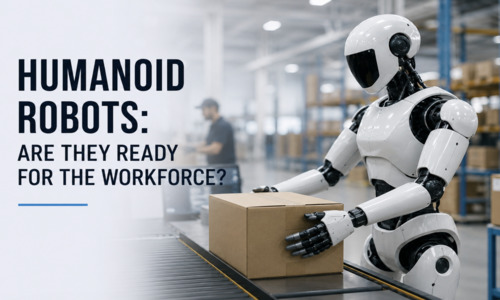
For decades, humanoid robots have existed mainly in science fiction, portrayed as intelligent machines capable of performing human tasks with ease. Today, rapid advances in artificial intelligence, machine learning, sensors, and robotics are bringing that vision closer to reality. Companies around the world are investing billions of dollars into developing robots that not only resemble humans but can also work alongside them. As industries face labor shortages and increasing demands for efficiency, the question is no longer whether humanoid robots will enter the workforce, but whether they are truly ready to become a part of it.
Recent years have witnessed remarkable progress in robotics. Leading technology companies such as Tesla, Figure AI, Boston Dynamics, and Unitree have introduced humanoid robots capable of walking, lifting objects, recognizing environments, and interacting with people. Advances in generative AI and large language models have further enhanced these machines, enabling them to understand instructions and adapt to changing situations.
Unlike traditional industrial robots that are confined to fixed environments, humanoid robots are designed to operate in spaces created for humans. Their human-like form allows them to use existing tools, navigate stairs, and perform tasks without requiring extensive modifications to workplaces.
Several factors are driving the growing interest in humanoid robots. Aging populations and labor shortages are creating significant challenges across industries. Manufacturing plants, warehouses, healthcare facilities, and logistics companies are struggling to find sufficient workers for repetitive and physically demanding tasks.
Humanoid robots offer the possibility of addressing these challenges while improving productivity. They can work continuously without fatigue, perform dangerous operations, and reduce workplace injuries. As technology advances and production costs decline, businesses view robotic workers as a long-term solution to rising labor costs and workforce constraints.
Manufacturing is expected to be one of the first sectors to adopt humanoid robots at scale. Robots can assist with assembly lines, quality inspections, and material handling, allowing human workers to focus on higher-value activities.
Warehousing and logistics represent another promising area. Humanoid robots can move packages, organize inventory, and support order fulfillment operations. Companies are increasingly exploring automation to meet the growing demands of e-commerce.
Healthcare may also benefit significantly from robotic assistance. Humanoid robots could help transport supplies, monitor patients, and provide support to healthcare professionals. In the future, they may even assist elderly individuals with daily activities, helping address the challenges posed by aging populations.
Retail, hospitality, and customer service industries are also experimenting with robotic assistants capable of greeting customers, providing information, and performing routine tasks.
Despite impressive technological progress, humanoid robots still face several limitations. Their movement and dexterity remain far below human capabilities. Tasks that humans perform effortlessly often require enormous computational power and sophisticated programming for robots.
Cost is another major barrier. Developing and manufacturing advanced humanoid robots remains expensive, limiting widespread adoption. Reliability and safety are equally important concerns, especially when robots are expected to operate in close proximity to people.
Ethical and social issues are also attracting increasing attention. Many workers fear job displacement, while policymakers are debating how automation will affect employment and income distribution. Questions surrounding liability, privacy, and regulation will become increasingly important as robots become more integrated into society.
Although fears of mass unemployment often dominate discussions, experts generally believe that humanoid robots are more likely to augment human workers rather than replace them entirely. Throughout history, technological revolutions have transformed jobs rather than eliminating work altogether.
Humans possess qualities that remain difficult for machines to replicate, including creativity, emotional intelligence, critical thinking, and complex decision-making. Instead of replacing people, robots are expected to handle repetitive and hazardous tasks while enabling humans to focus on areas that require judgment, innovation, and interpersonal skills.
The future workforce may consist of humans and robots working together in collaborative environments where each complements the strengths of the other.
Industry leaders predict that the next decade could mark a turning point for humanoid robotics. Improvements in artificial intelligence, battery technology, and computing power are expected to make these machines more capable and affordable. Some analysts believe that humanoid robots could eventually become as common as personal computers or smartphones.
However, widespread adoption will likely occur gradually. Early deployments will focus on specific industrial applications where the economic benefits are clear. As technology matures and costs decrease, humanoid robots may expand into broader sectors and eventually become a familiar presence in everyday life.
Humanoid robots are no longer a distant concept confined to science fiction. They are rapidly evolving into practical tools with the potential to transform industries and reshape the future of work. While significant technical and ethical challenges remain, their capabilities are improving at an unprecedented pace.
The real question may not be whether humanoid robots are ready for the workforce today, but how prepared society is for a future in which humans and intelligent machines work side by side. The next chapter of the industrial revolution may very well be defined by the rise of humanoid robots.
 Rajbir Singh, PhD
Rajbir Singh is a founder and Consulting Partner at Value Centria, a boutique business consulting firm that leverages customer centricity and digital to drive growth and innovation. Additionally, he is the co-founder and CEO of the i4 Mentors Foundation, a startup accelerator. As a not-for-profit, i4 Mentors Foundation is working for “Build for India”, and Healthcare is one of their focus sectors.
Before this, Rajbir led Global Business and IT Consulting businesses at IBM, Oracle, HCL Technologies and Tata Unisys for 25+ years. He has led large, multi-cultural teams spread across the globe and has consulted with Fortune 500 clients across industries, including BFSI, Media, Telecom, Utilities, CPG and Manufacturing. His areas of expertise include Customer Strategy, Innovation Strategy, Business Strategy and Change Management. He has received recognition from Forrester, Pega, SAP and HCL Tech for developing innovative products.
Rajbir has been a visiting faculty at IIIT Delhi, IIT Delhi, NSUT and BIMTech. He is also on the board of a few startup incubators.
Rajbir is an Electronics Engineer from IIT Delhi, an MBA from IIM Bangalore and a PhD from IIT Delhi.
Websites: https://www.valuecentria.in/; https://www.i4mentors.com/
 Sudarsan Chakravarthy
Founder, Chief Mentor & Success Coach – myDharma Global
A Spiritual leader, leadership coach, motivational speaker, accomplished global business leader, and an author with keen interests in ancient wisdom, spirituality, science, philosophy, and the arts.
An MBA from the Indian Institute of Management, Bangalore (IIM-B, Class of 93), India’s premier B-School, with a proven track record in building business, driving revenue & profitability growth and maximizing stakeholder delight.
Versatile and highly accomplished Management Professional with 25+ years of experience in the IT industry spanning across India, ME, Europe and North America.
Has rich experience across a wide range of areas – Digital Transformation, Line of Business Management, Business Operations, Sales, Marketing, IT Strategy, Operations, Finance, Product Management, and Service Delivery Management.
Worked with GBM (IBM GMSR) in Dubai for 20+years and championed several key strategies, including Business transformation, SAP implementation, Market Coverage, Growth Initiatives, Merger, Organizational restructuring, Low-cost services delivery, Market Research, IT Strategy, Business Partner / Channel Management, Operational Excellence, Sales Management, CRM, etc.
A motivational speaker with rich experience in running inspiring empowerment workshops; Has been inspiring and enthralling audiences of all age groups – individuals, groups, youth, families, corporate leaders – across several parts of the world with his captivating lectures; Meticulously gleans profound insights from the treasury of ancient wisdom and presents them in a way that illuminates the contemporary mind and resonates with today’s needs, interests, and challenges.
His life’s mission is to instill nobility and greatness across various strata of society.
Skillfully harmonizes the seemingly conflicting material and spiritual worlds and empowers individuals with a revitalising transformation and helps them to strengthen faith in their limitless potential; Is dedicated to unlocking the God given talents and highest abilities in people and empowering them to celebrate life through their unique contributions to the making of a new and beautiful world.

Subha Parthasarathy has been working with children, parents, and adults since 2006 and is the founder of Magichive. She is a Counselling Psychologist with over 20,000 counselling and training hours spent on 1-on-1 sessions with adults/children and group training sessions. Subha is an experienced trainer and facilitator who delivers workshops and programs that focus on enriching relationships with self and others. Her workshops “Chetana” (parenting workshop since 2009) and “Compassionate Communication based on NVC (since 2016)” are centred around increasing self-awareness and equipping participants with tools and insights that can help in leading an enriching life.
Person Centric Therapy, Mindfulness, and Nonviolent Communication form the cornerstones of her work. She is a Vipassana meditator and has certifications on various methods of interventions based on NLP, CBT, TA, NVC, Gestalt, Movement therapy, Reiki, Deep Listening, etc. She has delivered sessions in IIM Bangalore, IIM Kashipur, Infosys, Infosys BPO, Cap Gemini, Northern Trust, HSBC, etc.
Case Study: Case study on Magichive through Ivey Publishing, Ivey Business School, Canada (Click here for details) published in Oct 2024
Podcasts: Subha has hosted more than 20 free podcasts centred around mindfulness hosted on Spotify ( Click here for details)
Book: A book of 19 poems titled “Verses for Better – Parenting Lessons from Parenting Failures“, a collaborative effort between Magichive and Wunderman Thompson, was published in 2018. The book was nominated for two categories in the prestigious National Level Kyoorious Creative Awards 2019.