 Leadership is rarely black and white. While we often picture a leader as the person at the head of the table, the reality is that the way they lead can look radically different depending on the person, the team, and the situation.
Great leadership is not about memorizing a handbook; it is about understanding the different approaches available to you and knowing when to lean into each. Here is a breakdown of six distinct styles that shape our modern workplaces.
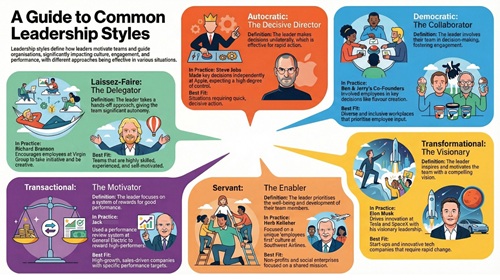
You know this leader when you see them. They are the ones talking about disrupting industries and going to Mars. Transformational leaders focus entirely on the big picture. They inspire their teams not through daily task management but by selling a compelling vision of the future. Elon Musk is often cited as an example, driving innovation at incredible speeds by convincing teams that the impossible is, in fact, possible. It is a style built for radical change, perfect for startups or organizations redefining their trajectory.
The term literally means let them do, and that is exactly how these leaders operate. They provide the resources and the destination, then step back and let the team drive. Richard Branson embodies this approach by giving Virgin Group employees enormous autonomy. This style is grounded in trust. It thrives when a team is skilled, ambitious, and self motivated. However, it can struggle when employees need guidance or structure.
On the other side of the spectrum is the Autocratic leader. Decisions are made individually and often without seeking input from the wider team. While this approach may sound rigid, it is sometimes the most efficient. Steve Jobs showcased this style through his strong sense of direction and uncompromising standards at Apple. It works best in crises, high risk environments, or situations requiring fast, cohesive action. The challenge is avoiding burnout or disengagement if it becomes the default leadership mode.
If the Autocratic leader says I decide, the Democratic leader asks “What do we decide together?” This style emphasizes participation and inclusivity. The co-founders of Ben and Jerry’s demonstrated this by involving employees in decisions from product ideas to social impact initiatives. It builds morale, strengthens community, and fosters creativity. However, the collaborative approach can slow things down when speed matters most.
Servant leadership turns the traditional hierarchy upside down. The role of the leader is to support and uplift the team rather than direct it from above. Herb Kelleher of Southwest Airlines famously championed this approach, believing that when employees are cared for, customers naturally will be too. This style encourages belonging, loyalty, and personal growth, especially in purpose driven or service centered organizations.
Transactional leadership relies on clarity, structure, and performance based outcomes. It operates through agreements: if you do X, you achieve Y. Jack Welch of General Electric is known for utilizing this method through performance evaluations that rewarded excellence and quickly addressed underperformance. While it may lack the emotional spark associated with transformational leadership, it is a highly effective model for sales teams, target driven environments, and results oriented cultures.
Most leaders are not bound to just one category. The strongest leaders are adaptable. They may be democratic when brainstorming a new product but shift toward an autocratic style when a deadline looms and decisions cannot wait.
The real power lies in knowing these approaches exist and recognizing which one to activate when the moment calls for it.
 Rajbir Singh, PhD
Rajbir Singh is a founder and Consulting Partner at Value Centria, a boutique business consulting firm that leverages customer centricity and digital to drive growth and innovation. Additionally, he is the co-founder and CEO of the i4 Mentors Foundation, a startup accelerator. As a not-for-profit, i4 Mentors Foundation is working for “Build for India”, and Healthcare is one of their focus sectors.
Before this, Rajbir led Global Business and IT Consulting businesses at IBM, Oracle, HCL Technologies and Tata Unisys for 25+ years. He has led large, multi-cultural teams spread across the globe and has consulted with Fortune 500 clients across industries, including BFSI, Media, Telecom, Utilities, CPG and Manufacturing. His areas of expertise include Customer Strategy, Innovation Strategy, Business Strategy and Change Management. He has received recognition from Forrester, Pega, SAP and HCL Tech for developing innovative products.
Rajbir has been a visiting faculty at IIIT Delhi, IIT Delhi, NSUT and BIMTech. He is also on the board of a few startup incubators.
Rajbir is an Electronics Engineer from IIT Delhi, an MBA from IIM Bangalore and a PhD from IIT Delhi.
Websites: https://www.valuecentria.in/; https://www.i4mentors.com/
 Sudarsan Chakravarthy
Founder, Chief Mentor & Success Coach – myDharma Global
A Spiritual leader, leadership coach, motivational speaker, accomplished global business leader, and an author with keen interests in ancient wisdom, spirituality, science, philosophy, and the arts.
An MBA from the Indian Institute of Management, Bangalore (IIM-B, Class of 93), India’s premier B-School, with a proven track record in building business, driving revenue & profitability growth and maximizing stakeholder delight.
Versatile and highly accomplished Management Professional with 25+ years of experience in the IT industry spanning across India, ME, Europe and North America.
Has rich experience across a wide range of areas – Digital Transformation, Line of Business Management, Business Operations, Sales, Marketing, IT Strategy, Operations, Finance, Product Management, and Service Delivery Management.
Worked with GBM (IBM GMSR) in Dubai for 20+years and championed several key strategies, including Business transformation, SAP implementation, Market Coverage, Growth Initiatives, Merger, Organizational restructuring, Low-cost services delivery, Market Research, IT Strategy, Business Partner / Channel Management, Operational Excellence, Sales Management, CRM, etc.
A motivational speaker with rich experience in running inspiring empowerment workshops; Has been inspiring and enthralling audiences of all age groups – individuals, groups, youth, families, corporate leaders – across several parts of the world with his captivating lectures; Meticulously gleans profound insights from the treasury of ancient wisdom and presents them in a way that illuminates the contemporary mind and resonates with today’s needs, interests, and challenges.
His life’s mission is to instill nobility and greatness across various strata of society.
Skillfully harmonizes the seemingly conflicting material and spiritual worlds and empowers individuals with a revitalising transformation and helps them to strengthen faith in their limitless potential; Is dedicated to unlocking the God given talents and highest abilities in people and empowering them to celebrate life through their unique contributions to the making of a new and beautiful world.

Subha Parthasarathy has been working with children, parents, and adults since 2006 and is the founder of Magichive. She is a Counselling Psychologist with over 20,000 counselling and training hours spent on 1-on-1 sessions with adults/children and group training sessions. Subha is an experienced trainer and facilitator who delivers workshops and programs that focus on enriching relationships with self and others. Her workshops “Chetana” (parenting workshop since 2009) and “Compassionate Communication based on NVC (since 2016)” are centred around increasing self-awareness and equipping participants with tools and insights that can help in leading an enriching life.
Person Centric Therapy, Mindfulness, and Nonviolent Communication form the cornerstones of her work. She is a Vipassana meditator and has certifications on various methods of interventions based on NLP, CBT, TA, NVC, Gestalt, Movement therapy, Reiki, Deep Listening, etc. She has delivered sessions in IIM Bangalore, IIM Kashipur, Infosys, Infosys BPO, Cap Gemini, Northern Trust, HSBC, etc.
Case Study: Case study on Magichive through Ivey Publishing, Ivey Business School, Canada (Click here for details) published in Oct 2024
Podcasts: Subha has hosted more than 20 free podcasts centred around mindfulness hosted on Spotify ( Click here for details)
Book: A book of 19 poems titled “Verses for Better – Parenting Lessons from Parenting Failures“, a collaborative effort between Magichive and Wunderman Thompson, was published in 2018. The book was nominated for two categories in the prestigious National Level Kyoorious Creative Awards 2019.