
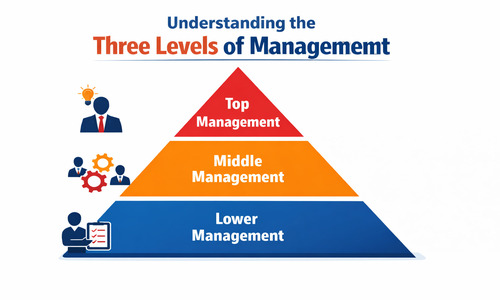
 Every organization functions through a clear hierarchy of management levels. These levels help in dividing responsibilities, improving coordination, and ensuring that long term goals are achieved through effective daily execution. The three main levels of management are top management, middle management, and low level management, each playing a distinct role in organizational success.
Top management is responsible for setting the overall direction of the organization. This level includes roles such as CEOs, directors, and senior executives. Their primary focus is on long term planning, defining the vision and mission, and making strategic decisions that shape the future of the organization. They analyze external factors like market trends, competition, and economic conditions to decide where the organization should head.
Middle management acts as a connecting link between top management and low level management. Managers at this level translate strategic goals into practical plans and policies. They are responsible for departmental planning, resource allocation, performance monitoring, and coordinating activities across teams. Middle management ensures that the objectives set by top management are realistically implemented.
Low level management focuses on day to day operations. This level includes supervisors, team leaders, and foremen who directly oversee employees and routine tasks. Their role involves assigning work, maintaining quality standards, managing schedules, and resolving immediate operational issues. Though their decisions are short term, they directly affect productivity and efficiency.
The three levels of management work together to ensure organizational effectiveness. Top management provides direction, middle management creates actionable plans, and low level management ensures smooth execution. Proper coordination among these levels helps organizations achieve their goals efficiently and sustainably.
 Rajbir Singh, PhD
Rajbir Singh is a founder and Consulting Partner at Value Centria, a boutique business consulting firm that leverages customer centricity and digital to drive growth and innovation. Additionally, he is the co-founder and CEO of the i4 Mentors Foundation, a startup accelerator. As a not-for-profit, i4 Mentors Foundation is working for “Build for India”, and Healthcare is one of their focus sectors.
Before this, Rajbir led Global Business and IT Consulting businesses at IBM, Oracle, HCL Technologies and Tata Unisys for 25+ years. He has led large, multi-cultural teams spread across the globe and has consulted with Fortune 500 clients across industries, including BFSI, Media, Telecom, Utilities, CPG and Manufacturing. His areas of expertise include Customer Strategy, Innovation Strategy, Business Strategy and Change Management. He has received recognition from Forrester, Pega, SAP and HCL Tech for developing innovative products.
Rajbir has been a visiting faculty at IIIT Delhi, IIT Delhi, NSUT and BIMTech. He is also on the board of a few startup incubators.
Rajbir is an Electronics Engineer from IIT Delhi, an MBA from IIM Bangalore and a PhD from IIT Delhi.
Websites: https://www.valuecentria.in/; https://www.i4mentors.com/
 Sudarsan Chakravarthy
Founder, Chief Mentor & Success Coach – myDharma Global
A Spiritual leader, leadership coach, motivational speaker, accomplished global business leader, and an author with keen interests in ancient wisdom, spirituality, science, philosophy, and the arts.
An MBA from the Indian Institute of Management, Bangalore (IIM-B, Class of 93), India’s premier B-School, with a proven track record in building business, driving revenue & profitability growth and maximizing stakeholder delight.
Versatile and highly accomplished Management Professional with 25+ years of experience in the IT industry spanning across India, ME, Europe and North America.
Has rich experience across a wide range of areas – Digital Transformation, Line of Business Management, Business Operations, Sales, Marketing, IT Strategy, Operations, Finance, Product Management, and Service Delivery Management.
Worked with GBM (IBM GMSR) in Dubai for 20+years and championed several key strategies, including Business transformation, SAP implementation, Market Coverage, Growth Initiatives, Merger, Organizational restructuring, Low-cost services delivery, Market Research, IT Strategy, Business Partner / Channel Management, Operational Excellence, Sales Management, CRM, etc.
A motivational speaker with rich experience in running inspiring empowerment workshops; Has been inspiring and enthralling audiences of all age groups – individuals, groups, youth, families, corporate leaders – across several parts of the world with his captivating lectures; Meticulously gleans profound insights from the treasury of ancient wisdom and presents them in a way that illuminates the contemporary mind and resonates with today’s needs, interests, and challenges.
His life’s mission is to instill nobility and greatness across various strata of society.
Skillfully harmonizes the seemingly conflicting material and spiritual worlds and empowers individuals with a revitalising transformation and helps them to strengthen faith in their limitless potential; Is dedicated to unlocking the God given talents and highest abilities in people and empowering them to celebrate life through their unique contributions to the making of a new and beautiful world.

Subha Parthasarathy has been working with children, parents, and adults since 2006 and is the founder of Magichive. She is a Counselling Psychologist with over 20,000 counselling and training hours spent on 1-on-1 sessions with adults/children and group training sessions. Subha is an experienced trainer and facilitator who delivers workshops and programs that focus on enriching relationships with self and others. Her workshops “Chetana” (parenting workshop since 2009) and “Compassionate Communication based on NVC (since 2016)” are centred around increasing self-awareness and equipping participants with tools and insights that can help in leading an enriching life.
Person Centric Therapy, Mindfulness, and Nonviolent Communication form the cornerstones of her work. She is a Vipassana meditator and has certifications on various methods of interventions based on NLP, CBT, TA, NVC, Gestalt, Movement therapy, Reiki, Deep Listening, etc. She has delivered sessions in IIM Bangalore, IIM Kashipur, Infosys, Infosys BPO, Cap Gemini, Northern Trust, HSBC, etc.
Case Study: Case study on Magichive through Ivey Publishing, Ivey Business School, Canada (Click here for details) published in Oct 2024
Podcasts: Subha has hosted more than 20 free podcasts centred around mindfulness hosted on Spotify ( Click here for details)
Book: A book of 19 poems titled “Verses for Better – Parenting Lessons from Parenting Failures“, a collaborative effort between Magichive and Wunderman Thompson, was published in 2018. The book was nominated for two categories in the prestigious National Level Kyoorious Creative Awards 2019.