
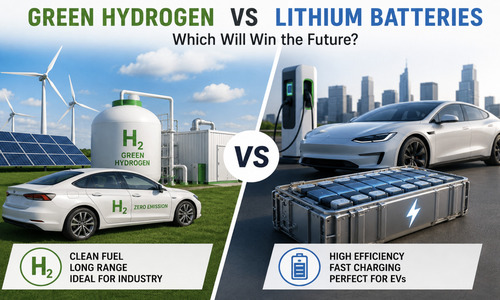
As the world accelerates toward clean energy and carbon neutrality, two technologies have emerged as the frontrunners in the battle for the future of energy storage and sustainability: green hydrogen and lithium-ion batteries. Governments, corporations, and investors are pouring billions into both sectors, hoping to secure dominance in what could become the defining energy revolution of the 21st century.
While lithium batteries currently dominate electric vehicles and portable energy storage, green hydrogen is rapidly gaining attention as a long-term solution for industries that batteries struggle to support. The question is no longer whether these technologies matter, but which one will lead the global energy transition.
Lithium-ion batteries have become the backbone of modern electrification. From smartphones and laptops to electric vehicles and grid storage systems, lithium batteries are already deeply integrated into everyday life. Their popularity comes from their efficiency, fast charging capability, and relatively mature infrastructure.
The electric vehicle boom has significantly increased demand for lithium, cobalt, and nickel. Companies like Tesla, BYD, and CATL have pushed battery innovation to unprecedented levels, reducing costs and improving energy density. Governments across Europe, China, and the United States are also supporting battery manufacturing to reduce dependency on foreign supply chains.
However, lithium batteries face several challenges. Mining lithium and rare earth materials raises environmental concerns, and battery disposal remains a growing issue. Additionally, batteries are not always practical for long-duration energy storage or heavy industrial applications where enormous energy loads are required.
Green hydrogen is produced by splitting water into hydrogen and oxygen using renewable electricity such as solar or wind power. Unlike grey hydrogen, which relies on fossil fuels, green hydrogen generates almost no carbon emissions during production.
Many experts see hydrogen as the missing piece in the clean energy puzzle. It can store renewable energy for long periods, power industries such as steel and cement manufacturing, and even fuel ships, airplanes, and heavy trucks where batteries may not be efficient enough.
Countries like Japan, Germany, Saudi Arabia, and India are investing heavily in hydrogen infrastructure. Large-scale hydrogen corridors, export hubs, and electrolyzer manufacturing plants are already under development. The technology is still expensive compared to batteries, but supporters believe costs will decline rapidly as adoption increases.
Lithium batteries currently enjoy a significant edge in terms of commercial adoption. The infrastructure for battery-powered vehicles is expanding rapidly, charging networks are growing globally, and manufacturing costs continue to decline every year.
Batteries are also highly efficient. A large percentage of stored electricity can be directly used, making them ideal for passenger vehicles and short-term energy storage systems. Consumers are already familiar with battery-powered products, which gives the technology strong market momentum.
In urban transportation, lithium batteries are likely to remain dominant for the foreseeable future. Electric cars, scooters, and consumer electronics rely on compact and fast energy delivery, areas where batteries outperform hydrogen systems.
Green hydrogen’s greatest strength lies in sectors where batteries are less practical. Heavy industries require continuous, high-intensity energy that batteries struggle to provide economically. Hydrogen can also be transported and stored more effectively over long durations, making it suitable for seasonal energy storage.
Long-haul trucking, aviation, and shipping are sectors where hydrogen may eventually become the preferred clean fuel. Hydrogen-powered fuel cells offer faster refueling times and lighter energy systems compared to massive battery packs required for large vehicles.
Hydrogen also presents an opportunity for countries rich in renewable energy resources. Nations with abundant sunlight and wind can produce green hydrogen at scale and potentially become major energy exporters in the future.
The competition between green hydrogen and lithium batteries is not just technological but geopolitical. China currently dominates much of the lithium battery supply chain, controlling large portions of rare earth processing and battery manufacturing.
Meanwhile, countries are racing to secure critical minerals and diversify supply chains. This has led to a new form of global competition often referred to as the “green resource race.”
Hydrogen offers some countries a chance to reduce dependency on mineral imports. Because hydrogen can be produced from water and renewable energy, it may reshape future energy trade dynamics in ways similar to oil and gas markets today.
Rather than one completely replacing the other, many experts believe green hydrogen and lithium batteries will coexist and serve different purposes. Batteries may dominate personal mobility and short-duration storage, while hydrogen powers heavy industry and long-range transportation.
The future energy ecosystem is likely to be hybrid rather than singular. Solar panels, batteries, hydrogen fuel cells, wind farms, and smart grids could all work together to create a more resilient and sustainable global energy system.
The real competition may not be between hydrogen and batteries themselves, but between nations and corporations trying to control the technologies, supply chains, and infrastructure behind them.
Lithium batteries have the advantage today because of their maturity, efficiency, and widespread adoption. However, green hydrogen holds immense long-term potential for transforming industries that batteries cannot fully support.
The ultimate winner may depend on which technology can scale faster, reduce costs more effectively, and solve the infrastructure challenges ahead. In reality, the clean energy future will likely need both.
As the world moves away from fossil fuels, the battle between green hydrogen and lithium batteries will shape economies, geopolitics, and industries for decades to come.
 Rajbir Singh, PhD
Rajbir Singh is a founder and Consulting Partner at Value Centria, a boutique business consulting firm that leverages customer centricity and digital to drive growth and innovation. Additionally, he is the co-founder and CEO of the i4 Mentors Foundation, a startup accelerator. As a not-for-profit, i4 Mentors Foundation is working for “Build for India”, and Healthcare is one of their focus sectors.
Before this, Rajbir led Global Business and IT Consulting businesses at IBM, Oracle, HCL Technologies and Tata Unisys for 25+ years. He has led large, multi-cultural teams spread across the globe and has consulted with Fortune 500 clients across industries, including BFSI, Media, Telecom, Utilities, CPG and Manufacturing. His areas of expertise include Customer Strategy, Innovation Strategy, Business Strategy and Change Management. He has received recognition from Forrester, Pega, SAP and HCL Tech for developing innovative products.
Rajbir has been a visiting faculty at IIIT Delhi, IIT Delhi, NSUT and BIMTech. He is also on the board of a few startup incubators.
Rajbir is an Electronics Engineer from IIT Delhi, an MBA from IIM Bangalore and a PhD from IIT Delhi.
Websites: https://www.valuecentria.in/; https://www.i4mentors.com/
 Sudarsan Chakravarthy
Founder, Chief Mentor & Success Coach – myDharma Global
A Spiritual leader, leadership coach, motivational speaker, accomplished global business leader, and an author with keen interests in ancient wisdom, spirituality, science, philosophy, and the arts.
An MBA from the Indian Institute of Management, Bangalore (IIM-B, Class of 93), India’s premier B-School, with a proven track record in building business, driving revenue & profitability growth and maximizing stakeholder delight.
Versatile and highly accomplished Management Professional with 25+ years of experience in the IT industry spanning across India, ME, Europe and North America.
Has rich experience across a wide range of areas – Digital Transformation, Line of Business Management, Business Operations, Sales, Marketing, IT Strategy, Operations, Finance, Product Management, and Service Delivery Management.
Worked with GBM (IBM GMSR) in Dubai for 20+years and championed several key strategies, including Business transformation, SAP implementation, Market Coverage, Growth Initiatives, Merger, Organizational restructuring, Low-cost services delivery, Market Research, IT Strategy, Business Partner / Channel Management, Operational Excellence, Sales Management, CRM, etc.
A motivational speaker with rich experience in running inspiring empowerment workshops; Has been inspiring and enthralling audiences of all age groups – individuals, groups, youth, families, corporate leaders – across several parts of the world with his captivating lectures; Meticulously gleans profound insights from the treasury of ancient wisdom and presents them in a way that illuminates the contemporary mind and resonates with today’s needs, interests, and challenges.
His life’s mission is to instill nobility and greatness across various strata of society.
Skillfully harmonizes the seemingly conflicting material and spiritual worlds and empowers individuals with a revitalising transformation and helps them to strengthen faith in their limitless potential; Is dedicated to unlocking the God given talents and highest abilities in people and empowering them to celebrate life through their unique contributions to the making of a new and beautiful world.

Subha Parthasarathy has been working with children, parents, and adults since 2006 and is the founder of Magichive. She is a Counselling Psychologist with over 20,000 counselling and training hours spent on 1-on-1 sessions with adults/children and group training sessions. Subha is an experienced trainer and facilitator who delivers workshops and programs that focus on enriching relationships with self and others. Her workshops “Chetana” (parenting workshop since 2009) and “Compassionate Communication based on NVC (since 2016)” are centred around increasing self-awareness and equipping participants with tools and insights that can help in leading an enriching life.
Person Centric Therapy, Mindfulness, and Nonviolent Communication form the cornerstones of her work. She is a Vipassana meditator and has certifications on various methods of interventions based on NLP, CBT, TA, NVC, Gestalt, Movement therapy, Reiki, Deep Listening, etc. She has delivered sessions in IIM Bangalore, IIM Kashipur, Infosys, Infosys BPO, Cap Gemini, Northern Trust, HSBC, etc.
Case Study: Case study on Magichive through Ivey Publishing, Ivey Business School, Canada (Click here for details) published in Oct 2024
Podcasts: Subha has hosted more than 20 free podcasts centred around mindfulness hosted on Spotify ( Click here for details)
Book: A book of 19 poems titled “Verses for Better – Parenting Lessons from Parenting Failures“, a collaborative effort between Magichive and Wunderman Thompson, was published in 2018. The book was nominated for two categories in the prestigious National Level Kyoorious Creative Awards 2019.