
Dates
Start Date: Tuesday, 21-July-2026
Register By: 01-July-2026
Early Bird Deadline: 20-June-2026
Program Fee
Regular: Rs. 30,000 + GST
Early Bird Fee: Rs. 24,000 + GST
Duration
Live-online, 8 weeks
2 sessions/week
Every Tuesday/Thursday: 7 PM to 8:15 PM IST
Click below to “Enroll and Pay” for the program – Enroll and Pay
Managers today face unprecedented complexity — balancing diverse expectations across a multi-generational workforce, navigating hybrid work dynamics, and responding to the volatility, uncertainty, complexity, and ambiguity (VUCA) of modern business environments. In such contexts, technical expertise alone is not enough; what differentiates effective managers is their ability to build, align, and sustain high-performing teams that deliver consistent results.
This program is designed to help managers deepen their understanding of the core drivers of team performance — trust, clarity of purpose, accountability, collaboration, and motivation. Through a blend of experiential learning and case discussions, participants will gain actionable insights into how to create an environment where individuals and teams can excel.
High-performance teams don’t happen because of talent; they happen because of deliberate routines that reinforce clarity, trust, and learning. Some of the interesting research findings are given below –
By the end of the program, participants will be able to:
Pedagogy
The program will be delivered live-online through an engaging mix of role plays, case discussions, videos, group activities, and reflective assignments. This experiential approach ensures that participants not only learn key concepts but also apply them to real-world team leadership challenges.
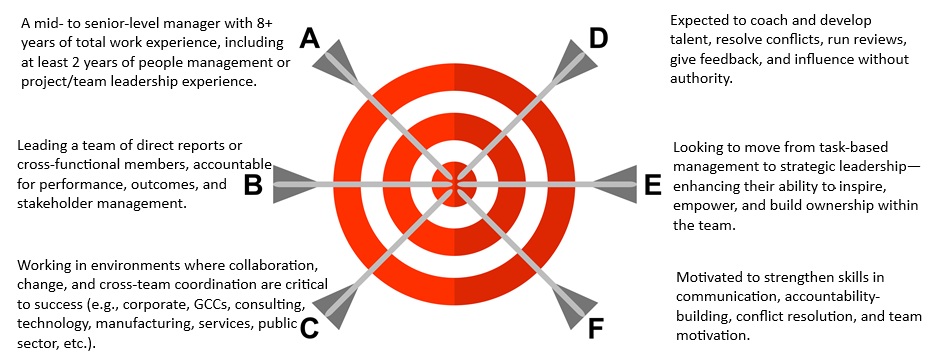
This program is designed for professionals who are currently responsible for leading teams and driving performance outcomes. The ideal participant would be:
Click below to “Enroll and Pay” for the program – Enroll and Pay
By the end of the program, participants will be able to:
Dr. Syed Hasan Ahmed is an HR and talent management leader with over 25 years of experience across Asia, Africa, and Europe. An Executive Fellow in Management (ISB Hyderabad) and PGDHRD from SCMHRD (Pune), his research focuses on how corporate purpose influences individual performance.
He has held senior leadership roles including Director–HR for a global FMCG organization ($1B revenue), Group HR Head for an Africa-focused FMCG company, and earlier worked with Amul, India’s largest FMCG food cooperative. He also brings entrepreneurial experience as co-founder & CEO of HR tech startup Gigvistas.com.
Hasan has led HR transformations, built HR functions from the ground up, and managed post-merger integrations involving culture, capability, and operating model redesign. His expertise spans talent strategy, leadership development, succession planning, assessment centers, 360° feedback, coaching, and organization development.
He is certified in MBTI, Thomas Assessments, Assessment Centre Design (Dr. T.V. Rao), Marshall Goldsmith Executive Coaching, and is a Global Fellow in Talent Management (Wharton). He works with organizations and leaders as a consultant and executive coach, supporting talent and leadership development initiatives globally.
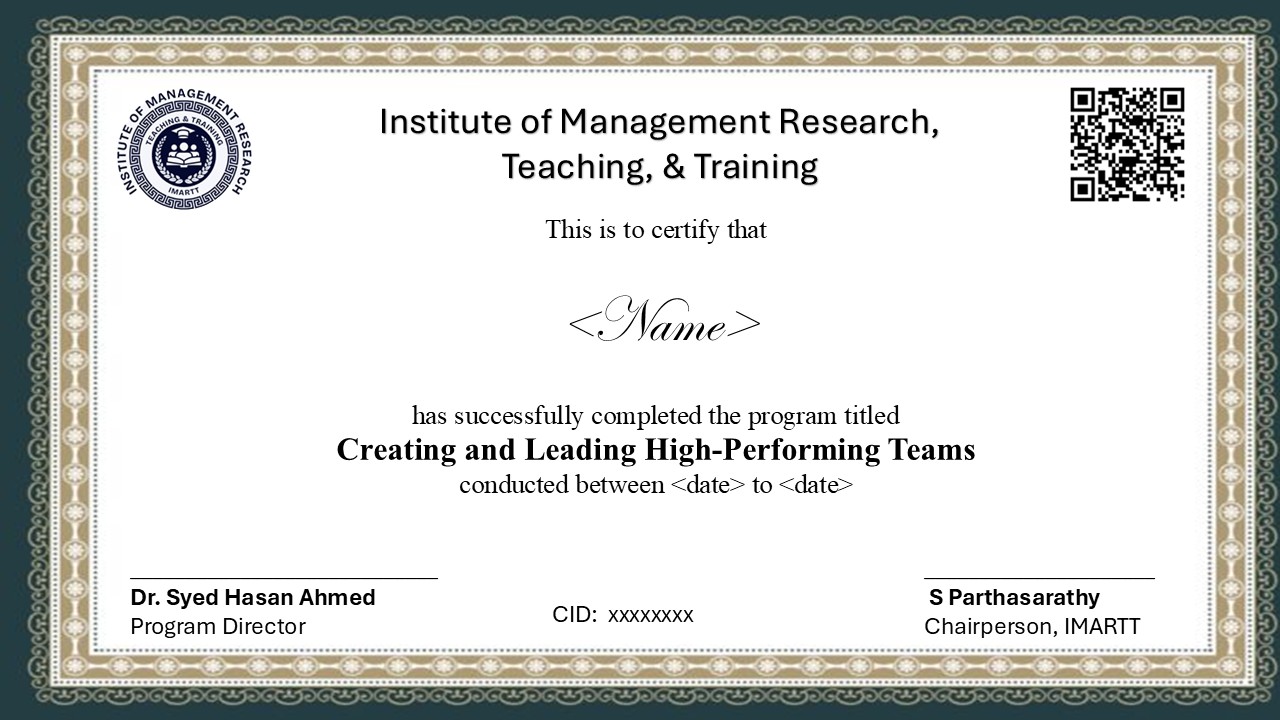
 The sample certificate image is for reference only and may change at the discretion of LabinMotion. The bona fides of the certificate can be verified by clicking on the QR code and entering the unique certificate number on the web page.
Schedule: Two sessions of 75 minutes each every week on Tuesday/Thursday: 7 PM to 8:15 PM IST
The program starts on Tuesday, 21-July-2026 and would run for 8 weeks. The program has a total of 15 sessions.
Delivery Mode: Live-Online through Zoom
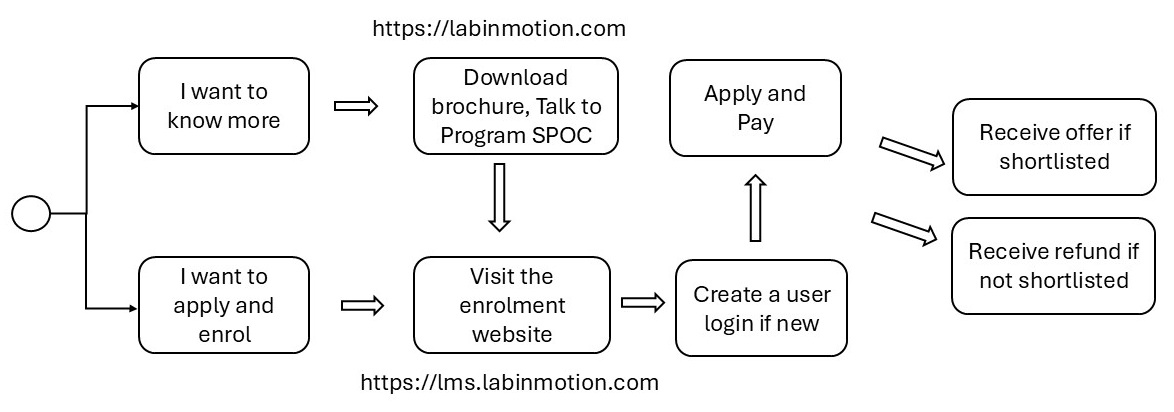
To enroll and apply for the program, click on the button below –
The payment and enrollment happen through our enrollment and learning management website – https://lms.labinmotion.com . We offer easy installment plans for all our programs. This can help plan your cash flows. We offer an additional 5% discount on group registrations for 3 or more people from a single organisation. Please email support@labinmotion.com for group registrations, and we will guide you through the enrollment process.
Parthasarathy S
Ph. +91 9110614400
Email: partha@labinmotion.com
Building a high-performing team starts with understanding people, motivation, and collaboration. The program on Strategic Management, Leadership and Emotional Intelligence strengthens these foundations through deeper self-awareness and influence.
Clear communication is essential for alignment and trust. The program on Effective and Empathetic Communication helps you share your ideas confidently and navigate conflict effectively.
Sustained team performance also depends on resilience and presence. The program on MindMastery: Leading from the Inside Out supports leaders in coaching and mentoring team members effectively and staying grounded under pressure.
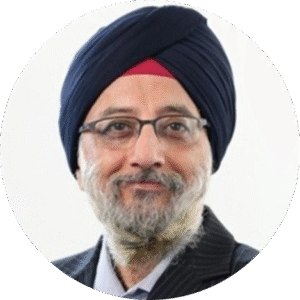 Rajbir Singh, PhD
Rajbir Singh is a founder and Consulting Partner at Value Centria, a boutique business consulting firm that leverages customer centricity and digital to drive growth and innovation. Additionally, he is the co-founder and CEO of the i4 Mentors Foundation, a startup accelerator. As a not-for-profit, i4 Mentors Foundation is working for “Build for India”, and Healthcare is one of their focus sectors.
Before this, Rajbir led Global Business and IT Consulting businesses at IBM, Oracle, HCL Technologies and Tata Unisys for 25+ years. He has led large, multi-cultural teams spread across the globe and has consulted with Fortune 500 clients across industries, including BFSI, Media, Telecom, Utilities, CPG and Manufacturing. His areas of expertise include Customer Strategy, Innovation Strategy, Business Strategy and Change Management. He has received recognition from Forrester, Pega, SAP and HCL Tech for developing innovative products.
Rajbir has been a visiting faculty at IIIT Delhi, IIT Delhi, NSUT and BIMTech. He is also on the board of a few startup incubators.
Rajbir is an Electronics Engineer from IIT Delhi, an MBA from IIM Bangalore and a PhD from IIT Delhi.
Websites: https://www.valuecentria.in/; https://www.i4mentors.com/
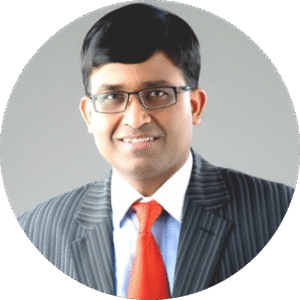 Sudarsan Chakravarthy
Founder, Chief Mentor & Success Coach – myDharma Global
A Spiritual leader, leadership coach, motivational speaker, accomplished global business leader, and an author with keen interests in ancient wisdom, spirituality, science, philosophy, and the arts.
An MBA from the Indian Institute of Management, Bangalore (IIM-B, Class of 93), India’s premier B-School, with a proven track record in building business, driving revenue & profitability growth and maximizing stakeholder delight.
Versatile and highly accomplished Management Professional with 25+ years of experience in the IT industry spanning across India, ME, Europe and North America.
Has rich experience across a wide range of areas – Digital Transformation, Line of Business Management, Business Operations, Sales, Marketing, IT Strategy, Operations, Finance, Product Management, and Service Delivery Management.
Worked with GBM (IBM GMSR) in Dubai for 20+years and championed several key strategies, including Business transformation, SAP implementation, Market Coverage, Growth Initiatives, Merger, Organizational restructuring, Low-cost services delivery, Market Research, IT Strategy, Business Partner / Channel Management, Operational Excellence, Sales Management, CRM, etc.
A motivational speaker with rich experience in running inspiring empowerment workshops; Has been inspiring and enthralling audiences of all age groups – individuals, groups, youth, families, corporate leaders – across several parts of the world with his captivating lectures; Meticulously gleans profound insights from the treasury of ancient wisdom and presents them in a way that illuminates the contemporary mind and resonates with today’s needs, interests, and challenges.
His life’s mission is to instill nobility and greatness across various strata of society.
Skillfully harmonizes the seemingly conflicting material and spiritual worlds and empowers individuals with a revitalising transformation and helps them to strengthen faith in their limitless potential; Is dedicated to unlocking the God given talents and highest abilities in people and empowering them to celebrate life through their unique contributions to the making of a new and beautiful world.

Subha Parthasarathy has been working with children, parents, and adults since 2006 and is the founder of Magichive. She is a Counselling Psychologist with over 20,000 counselling and training hours spent on 1-on-1 sessions with adults/children and group training sessions. Subha is an experienced trainer and facilitator who delivers workshops and programs that focus on enriching relationships with self and others. Her workshops “Chetana” (parenting workshop since 2009) and “Compassionate Communication based on NVC (since 2016)” are centred around increasing self-awareness and equipping participants with tools and insights that can help in leading an enriching life.
Person Centric Therapy, Mindfulness, and Nonviolent Communication form the cornerstones of her work. She is a Vipassana meditator and has certifications on various methods of interventions based on NLP, CBT, TA, NVC, Gestalt, Movement therapy, Reiki, Deep Listening, etc. She has delivered sessions in IIM Bangalore, IIM Kashipur, Infosys, Infosys BPO, Cap Gemini, Northern Trust, HSBC, etc.
Case Study: Case study on Magichive through Ivey Publishing, Ivey Business School, Canada (Click here for details) published in Oct 2024
Podcasts: Subha has hosted more than 20 free podcasts centred around mindfulness hosted on Spotify ( Click here for details)
Book: A book of 19 poems titled “Verses for Better – Parenting Lessons from Parenting Failures“, a collaborative effort between Magichive and Wunderman Thompson, was published in 2018. The book was nominated for two categories in the prestigious National Level Kyoorious Creative Awards 2019.